Agent assist AI is rapidly becoming one of the most powerful tools in customer service and sales environments. Platforms like iLounge and Business Growth are leveraging AI in call centers through data analytics to give human agents real-time guidance, suggested responses, and instant access to helpful information. This makes high-volume interactions easier to handle while improving both team productivity and customer satisfaction.
Many companies are now using cloud-based AI platforms for managing business data, which allows them to store, process, and analyze large amounts of information quickly and securely. With big data analytics for smarter business decisions, organizations can understand customer behavior, predict trends, and make faster decisions. Computer technology infrastructure supporting AI systems also helps teams collaborate better and ensures business operations run smoothly.
In addition to operations, AI tools for marketing automation and campaign optimization allow companies to reach the right audience, personalize messages, and improve engagement. Digital marketing strategies powered by artificial intelligence help businesses track performance, refine campaigns, and increase online reach efficiently. Even in finance, AI solutions for financial planning and predictive analytics support faster reporting, fraud detection, and smarter investment decisions.
By combining all these technologies, agent assist AI acts as a central tool that connects people, data, and processes. Using cloud computing systems for AI-driven business intelligence, big data insights for customer experience improvement, AI-powered marketing platforms, and financial analytics using machine learning, companies can empower agents to respond faster, work smarter, and deliver exceptional customer service.
This guide explains what agent assist AI is, how it works, and the practical benefits it delivers. You will also find use cases, key features to look for, and implementation tips to help you get real value from the technology.
Top 10 Contact Center Solutions for Agent Assist AI
When choosing a contact center platform that enhances agent productivity and customer experience, integrating agent assist AI is a key factor. These solutions use real-time guidance, intelligent routing, and data analytics to make interactions smoother and more efficient. Here are the top 10 contact center solutions you should consider:
1. Bright Pattern – AI-Powered Contact Center Platform

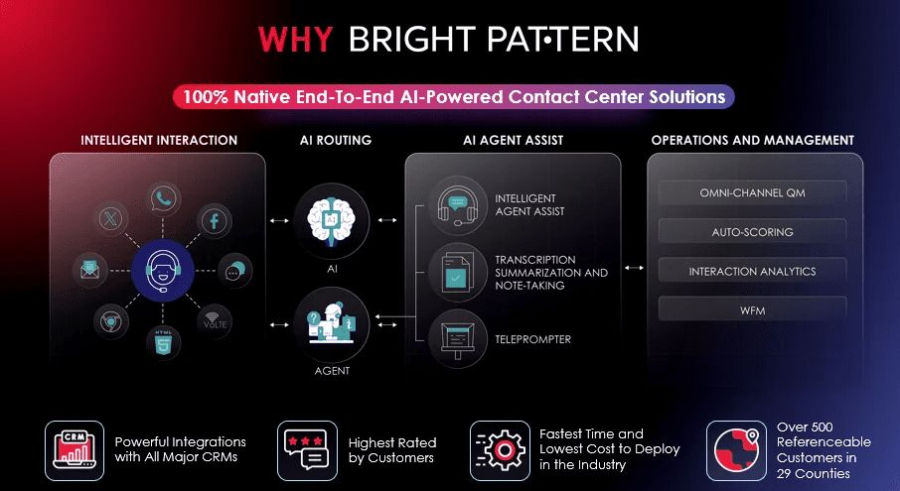
Bright Pattern is a leading cloud contact center solution designed to improve agent efficiency and customer engagement. Its advanced AI features help agents handle calls, chats, and messages with real-time suggestions, context-aware insights, and automated workflows. Bright Pattern integrates seamlessly with CRM systems and supports omnichannel communication for a complete customer experience.
Key features of Bright Pattern:
- Real-time agent assist AI for faster decision-making
- Omnichannel support including voice, chat, email, and social media
- Predictive analytics for smarter routing and customer insights
- Automated workflow and task management for agents
- Scalable cloud infrastructure for businesses of all sizes
Bright Pattern is ideal for organizations looking to implement intelligent contact center solutions that enhance efficiency, reduce agent stress, and improve customer satisfaction.
2. Genesys Cloud CX
Genesys Cloud CX offers AI-driven contact center solutions with intelligent routing, virtual assistants, and workforce optimization. It is suitable for enterprises aiming to enhance customer experience with smart automation.
3. Five9 Cloud Contact Center
Five9 provides AI-enhanced contact center software with features like predictive dialing, customer sentiment analysis, and real-time agent guidance. It helps teams scale operations efficiently.
4. NICE inContact CXone
NICE inContact CXone combines cloud contact center technology with AI to improve agent productivity, automate workflows, and provide advanced analytics for customer interactions.
5. Talkdesk CX Cloud
Talkdesk CX Cloud leverages AI to streamline customer support processes, optimize agent performance, and deliver a seamless multichannel experience.
6. RingCentral Contact Center
RingCentral offers AI-powered solutions for inbound and outbound communications, including real-time agent assistance, call routing, and customer analytics.
7. 8x8 Contact Center
8x8 Contact Center provides AI-enabled tools for customer engagement, including speech analytics, chatbots, and automated agent support to improve operational efficiency.
8. Zendesk Talk
Zendesk Talk integrates AI features into its cloud contact center, offering predictive routing, automated ticketing, and insights to enhance both agent performance and customer experience.
9. HubSpot Service Hub
HubSpot Service Hub uses AI and automation to streamline contact center workflows, provide agent recommendations, and analyze customer interactions for better decision-making.
10. Freshdesk Contact Center
Freshdesk Contact Center delivers AI-powered support, automated responses, and workflow management to help agents respond faster and more accurately across multiple channels.
What Is Agent Assist AI?
Agent assist AIis a set of artificial intelligence tools that support human agents during live customer interactions. Instead of replacing agents, it sits alongside them, providing real-time recommendations, knowledge, and automation that help them resolve issues faster and more accurately.
Agent assist AI typically works across channels such as:
- Voice calls in contact centers
- Live chat on websites or inside apps
- Email and messaging channels
- Social media and review platforms
While the agent talks or types with the customer, the AI listens in the background. It analyzes the conversation, looks up relevant information, and surfaces helpful suggestions on the agent’s screen.
How Agent Assist AI Works in Practice
Behind the scenes, agent assist AI combines several technologies:
- Natural language processing (NLP)to understand customer questions and intent.
- Machine learningto identify patterns in successful resolutions and improve over time.
- Knowledge retrievalto pull answers from FAQs, knowledge bases, policies, and past tickets.
- Workflow automationto trigger actions such as opening forms, filling fields, or escalating cases.
In a typical interaction, this is what happens:
- The customer asks a question or describes a problem.
- The AI detects key topics, sentiment, and intent in real time.
- It searches internal resources and previous cases for the best solution.
- Suggested responses, next best actions, or troubleshooting steps appear for the agent.
- The agent reviews, adjusts if needed, and responds to the customer with confidence and speed.
Core Benefits of Agent Assist AI
Organizations adopt agent assist AI primarily for its measurable business impact. Here are some of the most valuable benefits.
1. Faster Handle Times and Higher Throughput
Agent assist AI drastically reduces the time agents spend searching for answers, scrolling through documentation, or asking colleagues for help. Instead, answers appear directly in their workspace while they are talking or typing.
- Agents can resolve straightforward requests in a single interaction.
- Complex issues move forward faster because the AI suggests relevant steps and information.
- Supervisors spend less time on real-time handholding and more on coaching and strategy.
2. Better First Contact Resolution
Customers notice when issues are resolved on the first attempt. With agent assist AI, agents have a clearer view of history, context, and policies, so they are better equipped to provide complete answers.
- Unified contexthelps agents see previous interactions, orders, or cases.
- Policy-aware guidancekeeps resolutions compliant and consistent.
- Real-time promptsreduce the need for callbacks or follow-up emails.
3. More Consistent, Brand-Aligned Responses
When every agent writes responses from scratch, tone and accuracy can vary widely. Agent assist AI promotes consistency by suggesting messages, templates, and step-by-step flows that mirror your brand guidelines and policies.
- Suggested wording reflects your preferred tone of voice.
- Agents are nudged to include required disclosures and key messages.
- Customers receive equally high-quality support across channels and time zones.
4. Faster Onboarding and Skill Ramp-Up
New hires typically need weeks or months to become fully productive, especially in complex industries. Agent assist AI shortens this ramp-up period by acting as a real-time mentor.
- New agents no longer need to memorize every product detail or policy.
- On-screen guidance walks them through standard operating procedures.
- They build confidence sooner, reducing early attrition and training costs.
5. Reduced Agent Stress and Burnout
Support work can be intense: high volume, emotional interactions, and tight metrics. Agent assist AI relieves pressure by handling repetitive tasks and providing instant backup for challenging questions.
- Agents feel less alone when facing complex or emotional conversations.
- They spend more time on meaningful problem solving, less on tedious searching.
- Happier, more confident agents are more likely to stay with your organization.
6. Data-Driven Coaching and Continuous Improvement
Because agent assist AI observes every interaction, it creates a wealth of insight about what works and what does not. Leaders can use this to improve scripts, training, and processes.
- Identify top-performing responses and share them with the team.
- Spot knowledge gaps where documentation could be improved.
- Discover emerging customer issues early and adjust operations proactively.
Typical Agent Assist AI Features
Different solutions offer different capabilities, but most agent assist platforms include some combination of the following features.
Real-Time Recommendations
These features provide instant suggestions based on live conversation content.
- Suggested repliesfor common questions.
- Knowledge article recommendationsthat agents can open or send.
- Next best action promptsthat guide the conversation flow.
Automated Note-Taking and Summaries
After every interaction, agents typically need to document what happened. Agent assist AI can:
- Generate concise case summaries.
- Highlight key customer details and commitments.
- Pre-fill fields and tags for faster wrap-up.
Guided Workflows and Scripts
For regulated or process-heavy scenarios, agent assist AI can provide guided workflows that ensure compliance and consistency.
- Dynamic scripts that adjust based on customer responses.
- Checklists for mandatory steps, disclosures, or verifications.
- Embedded troubleshooting trees for technical issues.
Sentiment and Intent Detection
Understanding customer emotion and intent is essential for effective support. Agent assist AI can analyze language to detect:
- Frustration, urgency, or high-stakes situations.
- Opportunities to upsell, cross-sell, or retain at-risk customers.
- Moments when escalation or supervisor attention may be needed.
Knowledge Management Integration
Agent assist AI is most effective when tightly connected to your knowledge sources.
- Search across FAQs, manuals, and policy documents.
- Surface the most relevant passages instead of long articles.
- Make it easy for agents to provide feedback when content is outdated.
High-Impact Use Cases for Agent Assist AI
Agent assist AI is versatile and can be applied in many customer-facing functions. Here are some of the highest-impact scenarios.
Customer Support and Technical Helpdesks
In support environments, agent assist AI can:
- Provide instant troubleshooting steps for frequent technical issues.
- Guide agents through complex diagnostics for advanced problems.
- Suggest replacement, warranty, or repair options based on policies.
Sales and Inside Sales Teams
Sales agents benefit from real-time intelligence that helps them tailor their conversations.
- Surface relevant product or plan recommendations.
- Prompt agents with key qualifying questions.
- Suggest persuasive talking points and objection handling phrases.
Billing, Collections, and Account Management
For financial or billing conversations, accuracy and compliance are critical. Agent assist AI helps by:
- Providing clear policy explanations and payment options.
- Guiding agents through verification and security steps.
- Suggesting retention offers when customers consider leaving.
Regulated Industries
In industries such as finance, healthcare, and utilities, there are strict rules about what agents can and cannot say. Agent assist AI supports compliance by:
- Highlighting required disclosures at the right time.
- Warning when language could conflict with regulations.
- Recording consistent, auditable documentation of key statements.
What Makes a Strong Agent Assist AI Solution?
When evaluating platforms, it is helpful to look beyond buzzwords and focus on capabilities that drive real business value.
Accuracy and Relevance of Suggestions
The most visible success factor is how often the AI surfaces useful help.
- Are suggested responses on-topic and accurate?
- Does the system learn from corrections and improve?
- Can you fine-tune it using your own data and policies?
Ease of Use for Agents
Adoption is essential. Even powerful AI fails if agents find it confusing or disruptive.
- A clean, intuitive interface that fits into their existing tools.
- Minimal extra clicks or context switching.
- Clear controls so agents can accept, edit, or ignore suggestions.
Integration With Existing Systems
Agent assist AI works best when it is connected to the systems your teams already use every day.
- Contact center platforms and telephony systems.
- Customer relationship management tools.
- Helpdesk, ticketing, and knowledge base solutions.
Security, Privacy, and Compliance
Because agent assist AI processes live customer data, strong safeguards are non-negotiable.
- Support for data protection and privacy standards relevant to your region.
- Granular controls over data retention and access.
- Ability to mask or restrict use of sensitive information.
Analytics and Optimization Capabilities
An effective agent assist solution is not static. It should help you continuously improve operations.
- Dashboards tracking handle time, resolution rates, and customer satisfaction.
- Insights into which suggestions are accepted or edited.
- Tools to refine prompts, responses, and workflows over time.
Implementation Strategy: How to Roll Out Agent Assist AI Successfully
A thoughtful rollout plan will maximize adoption and benefits while minimizing disruption.
1. Start With Clear Goals and Metrics
Define the business outcomes you want before selecting or configuring tools.
- Examples include reducing average handle time, boosting first contact resolution, or shortening onboarding time.
- Choose a small set of measurable key performance indicators to track.
- Establish a baseline so you can quantify impact later.
2. Pilot With a Focused Use Case
Rather than deploying to every agent and every channel at once, start with a pilot.
- Pick a team or queue with high volume and relatively clear processes.
- Configure a small number of targeted workflows or suggestions.
- Collect structured feedback from agents and supervisors regularly.
3. Involve Agents Early and Often
Agents are closest to customers and know where friction exists. Their input is invaluable.
- Invite experienced agents to help design suggestions and workflows.
- Explain that the AI is a support tool, not a replacement.
- Celebrate quick wins, such as a tricky issue that becomes easy to handle.
4. Invest in Training and Change Management
Even if the tool is intuitive, short, focused training sessions accelerate adoption.
- Demonstrate how to accept, modify, or reject AI suggestions.
- Clarify expectations: agents remain accountable for the final response.
- Provide a clear channel for reporting issues or suggesting improvements.
5. Iterate Based on Data and Feedback
Agent assist AI becomes more powerful when tuned to your environment.
- Monitor key performance indicators regularly and compare to baseline.
- Refine knowledge content that the AI uses to generate suggestions.
- Retire low-value prompts and expand high-performing ones.
Real-World Outcomes: What Organizations Commonly Achieve
Organizations that implement agent assist AI thoughtfully often report a combination of the following outcomes:
- Noticeable reductions in average handle time and queue backlogs.
- Improvements in first contact resolution and customer satisfaction scores.
- Shorter onboarding cycles for new agents, measured in weeks instead of months.
- Higher agent engagement and lower turnover in high-pressure teams.
- More consistent, compliant communication across all channels and shifts.
Even modest gains in each area can compound into substantial operational savings and happier customers over time.
Best Practices for Getting the Most From Agent Assist AI
To fully realize the benefits, consider these practical best practices.
Keep Humans in Control
Agent assist AI should augment, not replace, human judgment.
- Make it easy for agents to edit all suggestions.
- Encourage them to use their experience and empathy in every interaction.
- Review transcripts and feedback to ensure quality remains high.
Continuously Improve Your Knowledge Base
The AI is only as strong as the information it can access.
- Keep articles up to date and easy to understand.
- Retire duplicate or conflicting content.
- Use data from the AI to prioritize which topics to update first.
Align AI Behavior With Brand and Compliance Requirements
Make sure the AI reflects your organization’s identity and obligations.
- Define tone of voice guidelines for suggested responses.
- Build in required language for specific scenarios.
- Regularly review samples to ensure alignment with policies.
Looking Ahead: The Future of Agent Assist AI
Agent assist AI is evolving rapidly. In the near future, organizations can expect even more powerful capabilities, such as:
- Deeper personalization based on customer history and preferences.
- Proactive alerts that recommend outreach before issues escalate.
- Richer collaboration between human agents, virtual agents, and back-office systems.
What will remain constant is the core value: empowering human agents with the information and guidance they need to deliver outstanding service, at scale.
Conclusion: Turning Every Agent Into a Top Performer
Agent assist AI is not just another contact center tool. It is a strategic capability that elevates the performance of your entire frontline team. By combining real-time intelligence with human empathy and expertise, it enables faster resolutions, more consistent experiences, and more confident agents.
With a clear strategy, thoughtful implementation, and ongoing optimization, agent assist AI can help you transform everyday customer conversations into a powerful driver of loyalty, efficiency, and growth.
